

Two Hundred Friends Online, and You Queued With Strangers Anyway
Nine years, 1.8 million gamers, and the small stubborn problem nobody solved: actually playing together.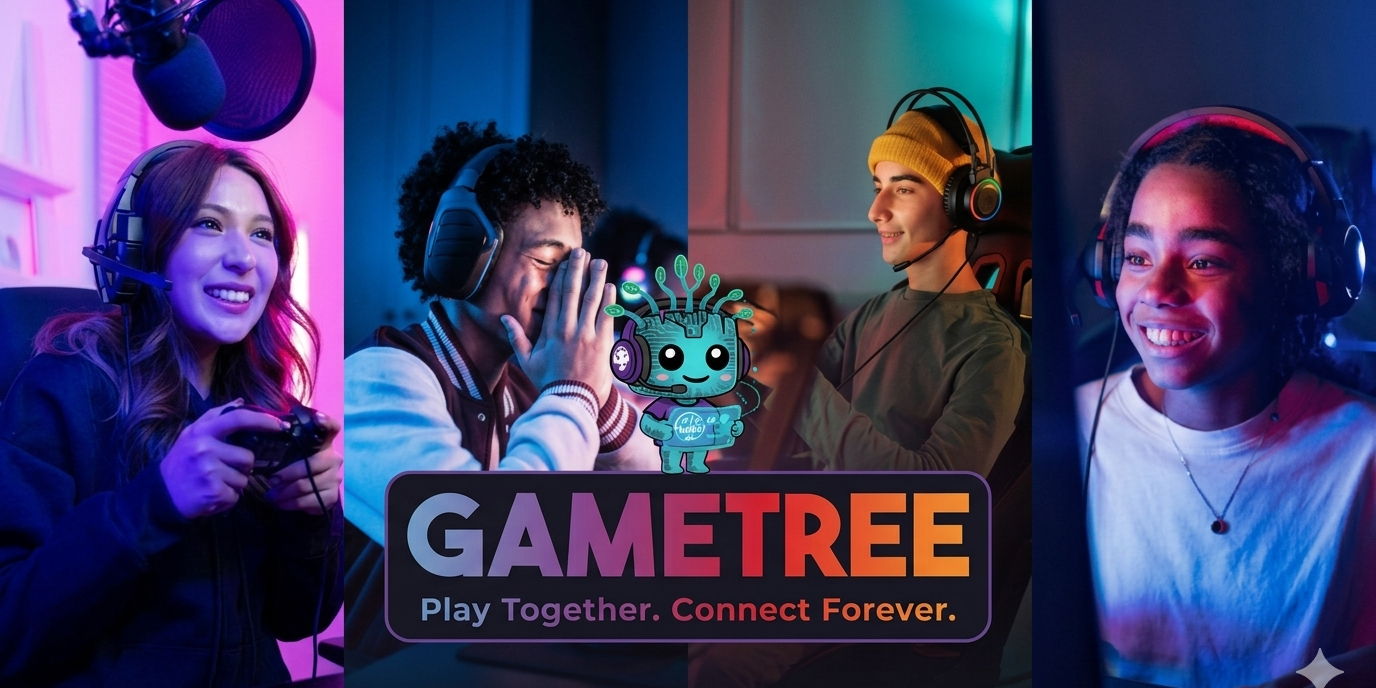
There's a moment almost every gamer has had, and almost nobody talks about.
It's a Tuesday night. You've got a couple of hours. You open your game, and there's your friends list — two hundred names, thirty of them online, green dots glowing like porch lights. Some of these people you've known for years. You've won things together. You've stayed up too late together.
And then you click Quick Match, and you play with four strangers who don't talk.
Not because you don't like your friends. Because messaging seven of them individually to ask "hey, you playing?" feels like organizing a group holiday. Because you don't know who's free, who's already in a match, who's on a different game tonight. Because the button that says play immediately is right there, and the path to playing with people you actually like is a dozen small frictions long.
That gap — between the people we have and the people we play with — is where I've spent the last nine years of my life.
The thing we built, and the flaw we couldn't see
GameTree started as a simple idea: gamers should be able to find people they'd genuinely get along with. Not just anyone with a mic and a matching rank — people with compatible personalities, humor, schedules, and taste. We built a matching app around it. A personality test. Deep interest matching. A profile that was actually you rather than a K/D ratio.
It worked. Over nine years, more than 1.8 million people signed up. We heard from players who'd found their main crew through us. People who met a duo partner and were still playing together three years later. A few who ended up at each other's weddings.
And here's the thing about that success, the thing that took me an embarrassingly long time to see clearly:
Every time GameTree worked, we lost the user.
They'd meet on GameTree. They'd exchange Discord tags. And then they'd go play together on Discord, forever, and never open our app again. Our best outcome and our churn event were the same event. We were a wedding chapel in a world where nobody comes back to the chapel.
We survived three near-death experiences over those nine years. One of them involved buying the company back out of insolvency. I've had the conversation where you tell your team you're not sure about next month. I've had the one where you tell your wife. If you've built something for a long time, you know the specific flavor of that — the way an identity gets braided into a project until you can't tell which one is failing.
What got us through wasn't optimism. It was a suspicion that the core observation was right and the shape was wrong. That people really do want to play with people they'd like. That we'd just built the wrong machine to give it to them.
The realization
Here's the reframe that changed everything, and I'll state it plainly because it took me years to arrive at it:
The problem was never finding people. It was coordinating them.
Think about your own gaming life. How many people do you already know who you'd happily play with? Twenty? Fifty? Two hundred? Most of us are not short on potential teammates. We're short on the mechanism that turns "we both like this game" into "we are in a voice channel at 8pm on Thursday."
And that mechanism has quietly gotten worse over the last decade, for a reason nobody planned:
Instant matchmaking made playing alone frictionless. It's an amazing piece of engineering and it removed the last practical reason to organize. When you can be in a match in eleven seconds with zero social effort, the four-minute effort of assembling friends starts to feel like work. So we do it less. And doing it less means our gaming friendships thin out, which means we have fewer people to call on, which means we solo queue more. It's a spiral, and most players are somewhere in it without ever having noticed they stepped in.
Meanwhile, the tools we do have for grouping are genuinely bad:
Messaging people one by one is tedious, and you're never sure who's actually free right now.
LFG channels are a wall of unanswered posts, mostly ignored, mostly stale.
@role pings — the standard solution — are the worst of all, and I want to spend a moment on this one, because if you run a community, you already know what I'm about to say.
The @everyone problem (or: how servers quietly die)
If you're a community owner, here's the sequence you've lived through.
Someone wants a group. They ping @LFG. Two hundred people get a notification. Three respond. The other hundred and ninety-seven got interrupted for nothing.
Repeat that fifteen times a day.
Now watch what happens: people don't leave your server. That would be visible, and you could react to it. They do something much quieter and much worse. They mute it. Your server is still in their list. Your member count still looks healthy. And they will never see another announcement, another event, another giveaway, another thing you worked on, for as long as they're in it.
Muting is the kiss of death for a community, and it's nearly invisible on your dashboard. You just notice, over months, that engagement got soft. That events don't fill like they used to. That the same twelve people are doing all the talking.
The tragedy is that this is a coordination problem being solved with a broadcast tool. Pinging two hundred people to find three is like using a fire alarm to ask if anyone wants coffee. It works exactly once, and then everyone learns to ignore the alarm.
That's the problem we finally decided to solve properly.
What Scout is
Scout is our LFG bot. It lives in your Discord server, and it's built on one principle that shows up in every design decision: your attention is sacred.
Here's what actually happens when someone wants to play.
They tap one button (or type /lfg). They set the game, and optionally: how many players, region, start time, skill level, a description. They choose who it goes to — a private group of their preferred players, their community, or the wider public network.
Then Scout does the part that no @role ping can do. Instead of blasting everyone, it sends targeted invites, in limited waves, to relevant players who are actually available — people whose games, hours, region, and preferences make them a real candidate. When the spots fill, the invites stop. If the session needs more people, it searches across servers in the network to fill faster.
Then it handles the coordination that usually falls apart:
Spins up a private group chat and voice call at go time — for live sessions or scheduled ones
Sends reminders before a scheduled session so it doesn't quietly evaporate
Cleans up the channels afterward so nothing clutters your server
Sends an after-session summary, with one tap to save the people you enjoyed playing with as preferred players — so next time, your group forms in a single click
That last piece is the quiet magic. Every good session makes the next one easier. You're not "finding randoms" over and over; you're accumulating a roster. Play with someone great on Thursday, and in three weeks they're a name in your circle who gets first invite. The tool gets better the more you use it, in exactly the way friendships do.
And on the receiving end, you are in complete control. You decide which games you'll accept invites for. Which servers can reach you. Which specific people. What hours you're available — outside them, invites don't ping you, and unseen invites auto-delete instead of piling up. You can approve, friend, or block anyone.
The result, for a community owner, is the thing you've wanted the whole time: more games actually happening in your server, without the notification spam that drives people to mute you.
GameTree: the public LFG hub
Here's the other half, and it's the part that solves the oldest problem in group-finding.
Any single community, no matter how great, has a thin pool at any given moment. You have four hundred members, but at 9pm on a Wednesday, maybe three of them want to play the same game as you. That's not enough for a five-stack. It's often not enough for a duo.
So we built the GameTree server as a public LFG hub — a shared pool that any community with Scout can tap into.
Your members keep playing in your server, with your people, under your culture. But when your own pool is thin, sessions can reach out into the wider network and fill from players in other communities who match. Forty servers with three interested players each isn't nothing — it's a full lobby. Cross-server pooling is what turns a dozen quiet communities into one lively one, without anyone giving up their home.
And because trust is the whole game when you're playing with someone new, reputation travels with people across servers. Show up when you say you will and you build standing. No-show repeatedly and that follows you too.
For players who don't yet have a community with Scout, the GameTree server is simply the front door: join it, and you can start finding groups immediately. Public LFG, open to anyone, all games welcome.
Why we're structured the way we are
GameTree is a Public Benefit Corporation. That's not decoration.
Most tech companies are legally obligated to maximize returns for shareholders. We're legally obligated to balance profit against our stated mission: to make gaming more fun and meaningful by making it more socially connected.
That matters more than it sounds, because the standard playbook for a product like ours is to maximize engagement — send more notifications, manufacture more urgency, make the app harder to put down. Every one of those moves would make our numbers go up in the short term and would betray the entire point.
Our success metric isn't time-in-app. It's whether people are playing together more, with people they actually like. If Scout pings you once this week and it results in a great three-hour session with two people who become regulars, that's a perfect week. That's the product working exactly as designed.
We also plan, further down the road, to open real ownership to the community itself — the people using this should be able to own a piece of it. When you're handling people's social lives and their data, "community-owned" shouldn't be a slogan you put in a deck. It should be on the cap table.
What I'm asking
If you've read this far, you're probably either someone who wants better games than solo queue, or someone who runs a place where people gather. Here's what I'd love from each of you.
If you run a community
Add Scout to your server. It's free. It takes about a minute. And what it gives you is the thing every community owner is actually competing for: stuff happening. Not more messages — more sessions. More members who log in and find a group waiting rather than an empty channel and a stale ping. Add link: https://discord.com/oauth2/authorize?client_id=1381987930406387773
You keep your culture, your branding, your rules. Scout just removes the friction between "I want to play" and "we're playing," and does it without training your members to mute you.
If you're the kind of owner who's watched a great server go quiet during a content drought, this is the tool for exactly that stretch — when the game isn't giving people a reason to log in, the people become the reason.
If you're a player
Join the GameTree server, or any server running Scout, and take it for a spin. Post a session for tonight. See who shows up. Save the ones you'd play with again. Join link: https://discord.gg/ENwQtBDcYE
Give it two or three sessions before you judge it. The first one is a group finder. By the third, it's a roster — and that's when you feel what we've been building toward this whole time.
If you just have ideas
Tell us. We're early, we're listening, and the fastest way to shape what this becomes is to say something now. Some of the best decisions in Scout's design came from a server owner describing a problem we hadn't thought about.
One last thing
There's a line on the site you're reading this on: infinite communities for infinite people. The belief that everyone has a place where they belong, and that the only real obstacle is that these places are scattered and hard to find.
I believe the same thing about the smaller unit inside those communities — the squad. The three or four people who make a Tuesday night worth clearing your schedule for. Most people have the raw material for that already sitting in their friends list, or one server away, or two clicks past a matchmaking button that's just a little too convenient.
Loneliness is the quiet epidemic of our time, and it's strange and a little sad that some of the most social technology ever built — games where millions of people occupy the same world — so often ends up being an experience people have alone, in a lobby, in silence.
It doesn't have to be that way. The friends are already there. The games are already there. What's been missing is the small, unglamorous machinery that gets everyone into the same voice channel at the same time.
That's Scout. That's what nine years, 1.8 million signups, three near-deaths, and one very stubborn belief have added up to.
Come play with us.
Scout in 60 seconds: https://youtu.be/QnrUEUBz9zo
Roadmap & Vision (the journey here is a CRAZY story): https://youtu.be/IPVXfSVgymc
GameTree web app (make an account for better matching): https://app.gametree.me/
Add Scout to your server: https://discord.com/oauth2/authorize?client_id=1381987930406387773
Scout Guide & Troubleshooting:https://gametree.me/docs/lfg-bot-introduction/
Questions, ideas, or want help getting your community set up? Reach out — we answer everything.
Community Connections
Copy this address to connect:
Copied to clipboard!
Enjoying Grivio? Create your own community hub — it's free!
Community Connections
Copy this address to connect:
Copied to clipboard!
Enjoying Grivio? Create your own community hub — it's free!
Testimonials
Add yoursBe the first to share your experience with this community!
Share Your Experience